The Missing Infrastructure: What Successful AI Adoption Actually Requires
Everyone is talking about AI. Most people have tried it. They asked it a question, generated an image, drafted an email. But there is a significant difference between experimenting with AI and actually deploying it as a functioning part of how work gets done. That gap is wider than most organizations realize, and rapid adoption of Agentic AI in the domain of software development is the clearest proof of what crossing it actually looks like.
Software teams are not just using AI to assist with tasks. They are using it to autonomously plan, build, test, and deploy working systems with a single person directing work that previously required a team. This is not a pilot program or a productivity experiment. It is a fully functioning AI-integrated workflow, operating in production, delivering real output.
Part of the explanation is training data. The internet contains an enormous volume of source code, and code is uniquely structured. Software compilers and interpreters demand precision, so the training material is clean, consistent, and richly annotated with documentation, tests, and commentary. This gives AI an exceptionally strong foundation for software work compared to most other domains.
But that is only part of the story. The training data explains why AI understands code. It does not explain why teams can trust an AI agent to act on that understanding at scale. For that, you need to look at something else entirely — the infrastructure that surrounds the work itself.
Understanding why software development got there first — and what made it possible — is the key to understanding what every other domain will need to do next.
From “Do This” to “I Want That”
For most of AI’s short history, working with it has felt like giving instructions to a very fast assistant. You tell it what to do, “summarize this document”, “write a function that sorts a list”, “translate this paragraph”, and it executes. You are the architect. The AI is the worker.
Agentic AI changes the relationship fundamentally. Instead of telling AI what to do, you tell it what you want.
The difference sounds subtle. It isn’t.
When you tell an AI what to do, you are decomposing the problem yourself. You’re deciding the steps, sequencing the work, and integrating the outputs. The AI handles individual tasks; you handle the strategy.
When you tell an AI what you want, you hand it the goal. The AI figures out the steps, sequences the work, executes across multiple actions, and delivers something complete. You describe the destination. The AI plans and drives the route.
This is the shift from AI as a tool to AI as an agent.
What Is the Deliverable?
Before you can work effectively with agentic AI, you need to ask a deceptively important question: what exactly is the deliverable?
This isn’t obvious, and the answer matters enormously.
Consider these examples:
| Request | Narrow Deliverable | Full Agentic Deliverable |
|---|---|---|
| ”Prepare a sales deck for the Q3 board meeting” | A PowerPoint file in your downloads folder | The deck drafted, reviewed against company guidelines, and emailed to the board with a calendar invite attached |
| ”Analyze our pipeline data” | A summary written in the chat window | A formatted report saved to SharePoint, with anomalies flagged and a Slack message sent to the sales team |
| ”Write and deploy the new authentication module” | Source code in a file | Code written, tested, reviewed, committed to version control, and deployed to the staging environment |
| ”Recommend a stock trade based on today’s data” | A written recommendation | An actual executed trade in your brokerage account |
| ”Book me a flight to Chicago next Tuesday” | A list of flight options | A confirmed ticket with a receipt in your inbox |
The gap between the narrow and the full agentic deliverable is not just a matter of convenience. It is a matter of consequence.
A recommendation you can evaluate. An executed trade you cannot easily undo. A PowerPoint file in a folder is inert. An email sent to the board is permanent. Source code in a file changes nothing. Running code in production changes everything.
As agentic AI becomes more capable of taking full agentic action — not just recommending but doing — the stakes of getting it wrong increase dramatically. Which brings us to the critical question: what stops an agent from confidently doing the wrong thing?
The Structured Verification Layer
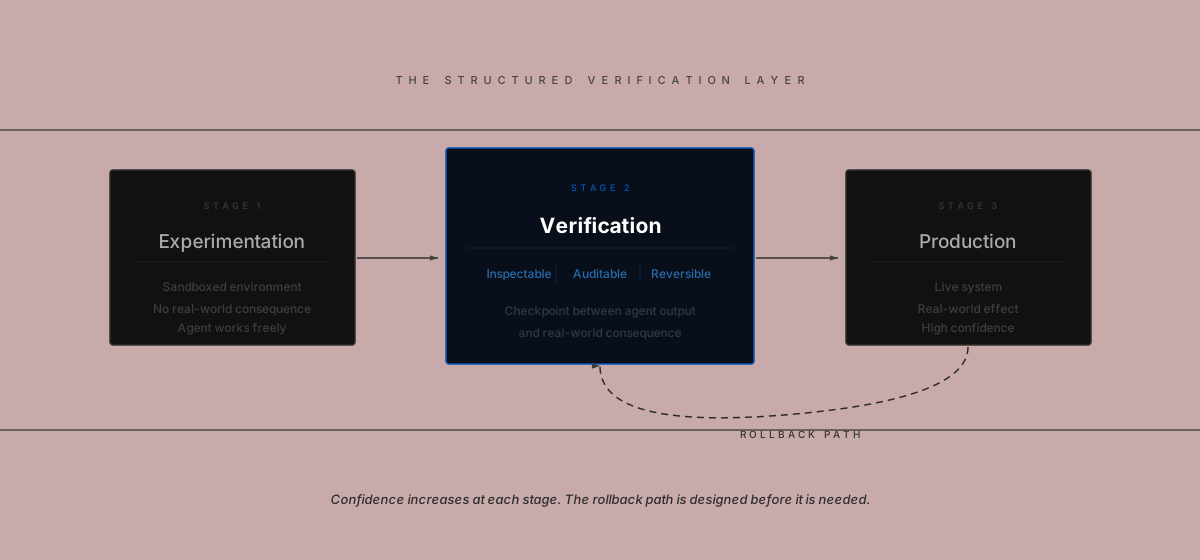
Every powerful system needs a mechanism to catch errors before they cause irreversible damage. For agentic AI, this is what we call the structured verification layer — a deliberate checkpoint between what the agent produces and what actually happens in the world.
The verification layer does three things:
- It makes outputs inspectable before they take effect
- It provides a rollback path when something goes wrong
- It creates an audit trail so you can understand what happened and why
Without a verification layer, agentic AI is fast and powerful but fragile. With one, it becomes something you can actually trust with consequential work.
The best real-world example of a structured verification layer — one that has been battle-tested for decades — exists in software development.
What Software Development Got Right
Software developers have been dealing with the problem of “powerful changes that can break things” for as long as software has existed. The solutions they developed are instructive for anyone thinking about agentic AI.
Version Control: Your Undo Button for Everything
The cornerstone of modern software development is version control, and the dominant tool is called Git.
Git is a system that tracks every change ever made to a codebase. Every time a developer (or an AI agent) makes changes, those changes are recorded in a commit — a snapshot of exactly what changed, when, and by whom. The entire history of every change is preserved indefinitely.
This has a profound implication: nothing is ever truly permanent. If a change breaks something, you can roll it back to any prior state instantly. If you want to understand why something is broken, you can trace the history of every modification. If an AI agent makes sweeping changes across hundreds of files, you can see every single one of them in a diff view — a side-by-side comparison of before and after.
Git also enables branching — the ability to make changes in an isolated copy of the codebase, completely separate from the live version. An AI agent can work freely in a branch, making as many changes as needed, without touching anything that affects real users. Only when the changes are reviewed and approved do they get merged into the main codebase.
For agentic AI, version control is transformative. It removes the most paralyzing fear of delegation: the fear that the agent will make changes you can’t undo. With Git, the agent can be bold and comprehensive. The safety net is always there.
The Dev/Test/Deploy Pipeline: Stages of Confidence
The second structural advantage of software development is the pipeline — the staged process through which code moves before it reaches production.
In most professional software teams, there are at least three environments:
- Development: Where changes are made and initially tested. Mistakes here have no impact on real users.
- Testing/Staging: A replica of the production environment where changes are validated more rigorously — automated tests run, QA teams verify, edge cases are checked.
- Production: The live system that real users interact with.
Code must pass through each stage before advancing to the next. This means that even if an AI agent introduces a bug, it will typically be caught in development or staging — long before it can cause harm in production.
This pipeline didn’t exist to accommodate AI. It was built because humans make mistakes too. But it turns out to be exactly the kind of structured verification layer that makes agentic AI safe to deploy for high-stakes work.
A Framework for Agentic AI Workflows
The lessons from software development generalize. Any organization wanting to work effectively with agentic AI should think about building equivalent structures around the workflows where agents will operate.
Here is a framework for thinking about it:
Experimentation — Let the agent work freely in a sandboxed environment where there are no real-world consequences. This is where you learn what the agent can do and how it behaves.
Verification — Before any output takes real-world effect, it passes through a review layer. For low-stakes outputs, this might be a quick human glance. For high-stakes outputs, it might involve automated validation, compliance checks, or multi-person approval.
Production — The verified output is applied to the real world. At this point, confidence is high because the verification layer has done its job.
Rollback — When something goes wrong despite verification (and sometimes it will), there is a defined path to reverse the change and restore a prior state. This path should be planned before it is needed.
The key insight is that the rollback path should be designed before you deploy the agent, not after something breaks.
Comparing Software and Non-Software Workflows
The table below illustrates how the software development model maps to other domains — and where the gaps are.
| Stage | Software Development | Marketing Campaign | Financial Reporting | Legal Document Drafting |
|---|---|---|---|---|
| Experimentation | Feature branch in Git; no impact on production | Draft campaign in sandbox account; no sends | Model built in test spreadsheet; no live data | Draft circulated internally; not filed or signed |
| Verification | Automated tests, code review, staging environment | Compliance review, A/B test with small segment, legal review | Controller review, variance analysis, audit check | Attorney review, redline markup, client approval |
| Production | Merge to main branch; deploy to live environment | Campaign goes live; emails sent, ads activated | Report published; filed with regulators or board | Document signed; filed with court or counterparty |
| Rollback | Revert commit; redeploy prior version in minutes | Pause campaign; suppression list; correction email | Restate report; issue correction; notify stakeholders | Rescind if pre-signature; amend if post-execution |
| Audit Trail | Full Git history; every change timestamped and attributed | Campaign activity logs; send history | Version history; change log | Document versions; tracked changes; signing record |
Notice that software development has the most mature, automated infrastructure at every stage. The other domains have equivalents — but they are often manual, slow, or incomplete.
This is why agentic AI will unlock the most value in software development first. The safety infrastructure was already there. For other domains, organizations will need to deliberately build it.
What This Means for You
If you are evaluating where to deploy agentic AI in your organization, the most useful question to ask about any workflow is: does it have a structured verification layer?
Not just “can humans review the output” — but does a formal, reliable process exist between agent action and real-world consequence? Is there a rollback path? Is there an audit trail?
Where the answer is yes, you can move quickly and confidently. Where the answer is no, the first investment should be building that infrastructure — because the risk isn’t that the AI will be malicious. It’s that it will be confidently wrong, and you won’t be able to undo it.
The organizations that get this right won’t just be using AI more safely. They will be using it more boldly — because the safety net allows ambition that caution would otherwise prevent.
The shift from AI as a tool to AI as an agent is already underway. The question is not whether to participate, but whether your workflows are ready for it.